Auto Pages: 2002 BMW M3 (E46): Engine Failure Concerns
Letters
· Notes
· Links
Now dubbed The Engine of Damocles*.
It came to my attention months ago that there is a spate of catastrophic engine failures. For more information on the rash of bad engines, due entirely, we believe, to failing crankshaft bearings or bearing shells. I created this page to document my concerns, including my letters to BMW and their responses, some of my thoughts and ideas, and links to other resources. I have to give credit here to a close friend, who used the expression Sword of Damocles in reference to these troubled S54 engines.
If your engine has failed, please be sure you report the incident to Jason's Engine Failure Archive right away.
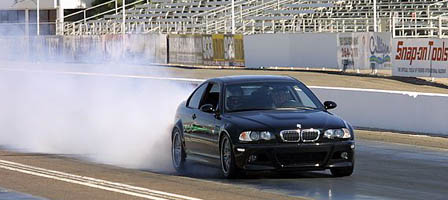
What we know so far, with a high degree of confidence:
- Nearly one-hundred cars to date have been reported to the M3 Engine Failure Archive (see Links, below). This excludes many other cars belonging to folks who are unaware of the Internet discussion, don't speak English, don't choose to report the failure, etc.
- Based on what we know of production numbers and extrapolating from them, perhaps five-hundred or more S54 engines have failed.
- Worse (for me anyway), approximately 10% to 15% or more 11/01 production cars have had engine failures
- The majority of these failures, over 70%, occurred in cars produced between October and December of 2001.
- A few of these failures occurred in cars produced before October 2001 and in 2002.
- The center most rod bearings, #3 especially, have failed in many of the cars reported.
- Few, if any, of these cars were mistreated, such as having been seriously over revved of having had incorrect oil used in them.
- Crankshaft bearing damage is generally not caused by over-revving the engine; overrev will first cause valvetrain failure. Further, many of the cars reported are SMG-equipped cars, which, in theory, cannot be over revved (unless one accelerates at just the right moment over a steep hill, yeah).
- Most of these failures were one or more "spun rod bearings," with the resultant pinging, clanking vibration.
- Some of these engines failed catastrophically, with punctured blocks and huge clouds of burnt oil and coolant pouring from the engine compartment. Based on my careful reading of the ninety-plus failures to date, at least 13% of documented failures posed a serious hazard
- BMW has replaced most of these failed engines under warranty, but some owners, especially early-on, were blamed for the failures and charged some or all of the replacement cost, which is approximately $17,000 US retail.
BMW AG and BMW NA have not yet really admitted the problem or its scope. Their letters usually refer to proper maintenance and use, which makes many owners nervous, fearing that they'll be blamed should their engine fail.
So, is the problem yet solved? Maybe not, what with newer cars beginning to fail here and there. I began trying to communicate with BMW of North America in August. See my letters and their responses, below.
To contact me with any suggestions or comments regarding this issue, click here.
My Third Letter to BMW NA - sent 10.18.2002
Having never received a personal response from BMW NA or my dealership and having seen no evidence that BMW is doing anything other than waiting for engines to fail, I could no longer contain my frustration. I wrote this, my third letter to BMW NA. In it I mention, again, the significant risk of injury or death when these engines fail, what I would like BMW to do for us, and what we may do if the company does not take some major steps to solve this problem.
BMW North America's Next Form Letter - received 09.06.2002
This is the response I finally received to my first letter (below). In this form letter, received by a number of owners, they say they are "evaluating every situation there engine damage occurs and are currently analyzing failed engines to determine the cause." This is a decent start, at last, though I have a few problems with this letter. They talk only of replacing engines that fail due to a defect; they do not suggest any plan to proactively prevent any of us from having the engine fail in the first place. Further, they again spend half of the letter harping on proper maintenance, though they at lease begin the phrase with "Respectfully,..." You can read this letter here.
My Second Letter to BMW NA - sent 09.04.2002
After receiving their general mailing (below), I was irate. I have not heard from BMW NA or from my dealership (which I copied on the original letter). Following is my second letter to BMW NA. I think that, if this doesn't elicit some direct contact, I may go to the media with something.
BMW North America's Form Letter - received 08.30.2002
I would have to characterize this letter as condescending marketing bullshit. If it was sent in response to my letter, it entirely misses the point. You really ought to read this letter, which I copied verbatim to this site. It begins with marketing crap, then addresses the following issues: proper engine oil changes, proper transmission and real axle differential oil changes, use of premium gasoline (in bold, no less), proper engine break-in, proper engine warm-up (with more bold type), and avoidance of overrev conditions. End with more marketing dribble, and you've got the gist.
My Initial Letter to BMW NA - sent 08.17.2002
In my initial letter, I wrote to BMW North America to express my concerns about the atypical number of engine failures in these cars. I noted that the preponderance of failures is in November 2001 production cars such as mine. I expressed concerns regarding safety and warranty and made clear my disappointment that BMW has not done anything to reassure owners of cars that may be affected. You may read letter I sent to BMW NA.
[top of this page]
10.18.2002:
Time has dragged on while I drive the car with the Engine of Damocles. I haven't seen any sign of things improving for BMW M3 owners. Perhaps it's just frustration, perhaps it's timely, but I had to send off another letter into the void that is BMW Customer Service. How long are they going to wait to contact us individually? How long until I can feel confident in my expensive new car? Am I going to be the one who gets hurt if/when my engine fails at just the wrong moment? I'm sick of waiting. It's time to shake things up. This is too important an issue for us to be passive. I'm ready to start organizing owners and to consider turning to the press and/or a lawsuit. Sure, the press has been quiet. They'll run the story, though, if the safety issue is made clear enough. BMW had better do something soon, or we'll all suffer in some way.
9.9.2002:
Here are my thoughts on the situation now. It seems that even early 2002 production cars have some tendency to fail. Some statistically- and logically-talented folks on the Roadfly Forum have theorized that there are at least two failure modalities: an early failure one that plagues cars with the 'red bearings' and another which can affect cars produced before and after the bearing switch. This means to me that, even if they replace my engine tomorrow (not likely), it, too could fail. I want to begin thinking of what remedies are acceptable. First, here are my concerns:
- Safety: I do not believe it is reasonable or prudent to insist owners of cars produced in the high-risk time period drive until they experience engine failure. If the engine goes in the most dramatic fashion (a punctured block, which has happened more than once), it could all too easily result in injury or death.
- Reliability: I demand an extremely reliable car when spending so much money with a major auto manufacturer. Wondering if it'll blow at any given moment detracts greatly from the ownership experience.
- Warranty: If there continues to be such a high likelihood of failure, I don't want to be responsible for engine replacements in the future, even after the standard warranty has expired. I expect to have a car free of defects as the basis of my warranty agreement.
- Resale Value: People are already starting to dump these cars to avoid this engine failure issue. Others are avoiding the model and certainly those cars produced in the high-risk period when buying used M3s. I don't want my investment in the car to be devalued because of a manufacturing problem and BMW's subsequent mishandling of the situation.
Here are some ideas for directions BMW can take with owners. Perhaps they're not all feasible, few are likely, but all would go some way towards winning back my loyalty and preventing legal action.
- Level with us: Give us the exact reason(s) for the failures, some honest statistics, and a BMW gamelan for dealing with this situation.
- Buy back the cars: If BMW would buy back my M3 for what I paid, I'd be out the interest paid to date on my loan. That's alright, as I'd then be free to decide what's next in my garage. Even with things as they are, I'd likely buy a new, hopefully problem-free M3.
- Replace all suspect engines immediately: This or the above buy-back idea are the only ways to ensure public safety. I'm not willing, as I cannot overstate, to continue driving something this dangerous indefinitely.
- Provide greatly extended warranty: Some have suggested a transferable seven-year, 100,000 mile powertrain warranty. This would help to a great degree in overcoming reliability concerns and bolstering resale values.
9.6.2002:
So, I just received BMW North America's Response to my initial letter. Had I received this earlier and had I not received the insulting Form Letter, I may have been somewhat appeased. As things stand, this letter, too, has far too great a focus on proper use and maintenance, which makes me nervous and angry, since we're dealing with an engineering/production/assembly issue here, not operator error. At least this letter makes some reference to engine failures, though it falls far short of really levelling with us. Another glaring problem, in my eyes, is the focus on replacing engines after they fail. I don't want to wait and see if/when the engine implodes. I want it fixed now. I just don't see how they can ask me to drive a $60,000 time bomb. Ugh, more later, I'm sure.
8.30.2002:
Perhaps there is another letter in the works that will arrive, addressed to me personally, addressing my specific concerns, and actually signed by someone at BMW NA. In the absence of such a letter, I currently feel both insulted and vaguely threatened by BMW North America's form letter. The owner's manual details proper operation of the car. I can read; I did read the manual. The BMW dealership should be well aware of which fluids to use in the car. What concerns me is the number of failures in cars that have, to my knowledge, been broken-in and operated properly.
I took maintenance one small step further, changing my engine oil at about 2,500 miles, using the specified BMW 10W-60 oil, of course, in addition to the oil change indicated by my Service Interval Indicator at 9,600 miles. I did so because I don't believe the oil would have been clean enough at the specified interval and because a BMW service tech said it would be well-advised. I still believe this expensive special 10W-60 oil is just another money-making ploy by the manufacturer. Other high-performance cars operate with readily-available synthetic 10W-50 oil without engine failures.
What concerns me most is that the letter seems to focus on operator error. It does not even hint at BMW being aware of a real problem with some engines, nor does it reassure me that BMW will stand behind me should my engine fail. I did not spend well over $50,000 to be chided like a naughty teenager about proper care of my vehicle.
[top of this page]
- The BMW E46 M3 Engine Failure Archive is maintained by Jason, a Roadfly member. This is the primary home of all engine failure data, with individual listings of all engine failures as reported to him, statistical and technical analyses of the situation, links, a picture gallery, and a collection of correspondence between BMW and owners.
- ///Mfailure.com is an index to Roadfly.com and M3Forum.com posts on engine failures.
- The Roadfly.com E46 M3 Forum is where most of the online discussion seems to be taking place.
- The National Highway Traffic Safety Administration Consumer Complaints Database is where users can search NHTSA archives for complaints specific to a vehicle model, type of equipment, child seat, or tire complaint. As of 9.9.02, I saw only one complaint filed in March. Why so few? Owners who have had their engines fail must file here, for all our sakes, even if the issue has been resolved for them as individuals, the NHTSA should be made aware of the situation.
[back to M3 page]
· [top of this page]
Copyright © 2002 John Turkel. All rights reserved. Not affiliated or endorsed by BMW AG or BMW North America. All trademarks are the property of their respective holders. This material is for entertainment purposes only.
Last Modified October 21, 2002
/
Visit 2867 since August 30, 2002.
auto, car, Bavarian Motor Works, BMW, BMW M3, BMW E46, E46 M3, M 3, M3, Bimmer, Beamer, Beemer, engine failure, blown engine, rod bearing, crankshaft bearing failure, failed engine, replace engine, damage, thrown rod, spun bearing, warranty, auto, car, Bavarian Motor Works, BMW, BMW M3, BMW E46, E46 M3, M 3, M3, Bimmer, Beamer, Beemer, engine failure, blown engine, rod bearing, crankshaft bearing failure, failed engine, replace engine, damage, thrown rod, spun bearing, warranty